Start here: what the program actually is.
The Amazon Influencer Program is Amazon's affiliate-and-content channel built around its on-site review video format. Approved creators get four things at once: a public storefront, an affiliate engine on every link, the ability to upload short videos directly onto product detail pages, and a payout relationship with Amazon itself.
Anyone can apply. Most don't get in. The creators who do mostly don't know how to work it — and that's where most of the opportunity sits unclaimed.
- Storefront. A curated grid of products on amazon.com, owned by the creator, with affiliate links baked in.
- On-site review. A short video that plays on the product detail page itself — next to the buy button, not on a separate platform.
- Commission. Small percentage on every sale that comes through the creator's links. Paid monthly by Amazon.
- Brand deals. Separate from Amazon. Negotiated directly with brands. Where the real upside lives.
Why on-site reviews convert.
An on-site Amazon review video plays where the decision happens — on the product page itself, while the shopper is already deciding whether to add to cart. That changes everything about what the video has to do.
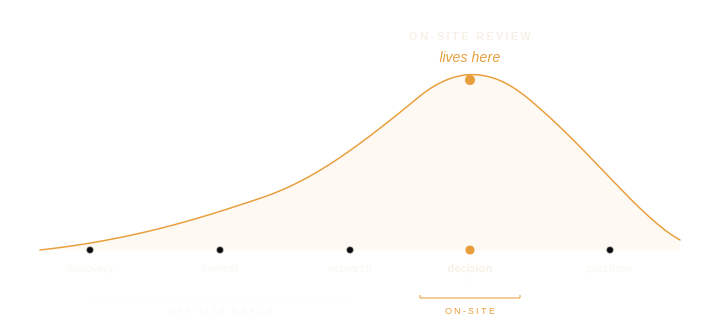
Amazon shoppers don't trust your hero image. They trust the 30-second review from someone who's actually opened the box.
The video doesn't have to create awareness; the shopper found the listing on their own. It doesn't have to compete with feed algorithms; it's the only video on the page. It just has to answer the question every Amazon buyer is asking before they click Add to Cart: is this real, and is it the one I want?
That's why the format rewards honesty more than polish. Amazon's policies push creators toward unscripted, on-camera, hold-the-box, show-the-thing video. Shoppers can smell a performance. They can't smell a person.
How creators actually earn.
There are three revenue streams in the program. Most creators see one.
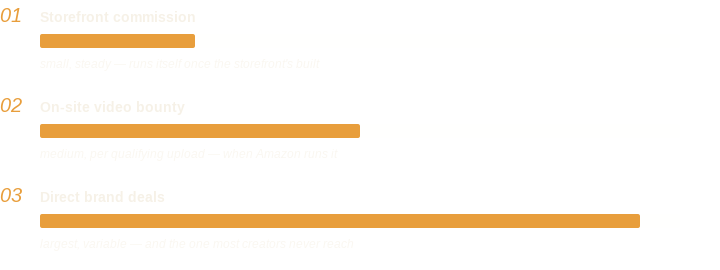
- Storefront commission. A small percentage on every sale that comes through the creator's affiliate links. Accrues monthly. Compounds with storefront depth.
- On-site video bounty. Where Amazon runs a bounty program, a small flat fee per qualifying upload, plus continued commission on attributed sales.
- Direct brand deals. Flat fee plus performance terms, negotiated directly with brands. Independent of Amazon. Almost always the largest of the three, when it shows up at all.
The first two come from Amazon and run themselves once the storefront is built. The third comes from brands directly — and is where the real income lives. But it requires outreach, contracts, briefs, deliverables, and follow-up that most creators won't do alone, and shouldn't have to.
What brands miss when they DIY.
Brands try direct outreach. They scrape lists of "Amazon influencers," ship dozens of products, and hope. Most don't film. The ones that do, film inconsistently. The ones that film well, never get a brief that ties the message to the listing.
- Scattershot reach. Lists are noisy. Sends are unvetted. Conversion math gets buried in averages.
- No quality control. Without briefs, videos repeat the listing copy. Shoppers tune them out.
- No reporting tied to the ASIN. Most brands can't tell which videos drove which conversions.
- Lost packages, ghosted creators, expired deals. The operations cost is invisible until you tally it up.
The DIY math looks cheap up front. The conversion math, run end to end, says otherwise.
The back office gap.
The program rewards the creator who treats it like a business. Most creators treat it like a side channel. The gap between those two states is the entire reason this agency exists.
Running it like a business means doing the work that doesn't show up on camera:
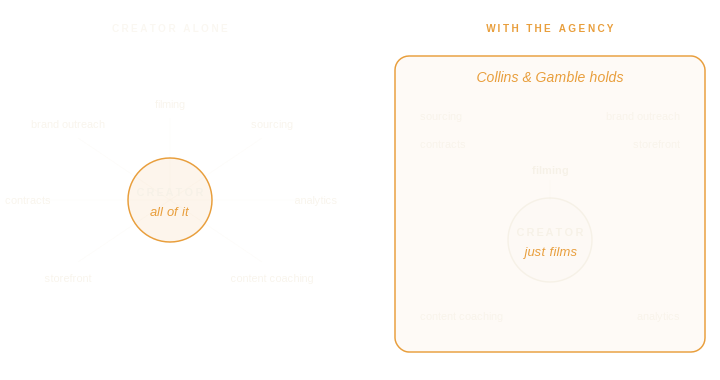
- Sourcing brands. Outbound, vetting, alignment. Knowing which brands match which creators.
- Negotiating deals. Rates, exclusivity windows, deliverables, kill fees. The boring paperwork that protects both sides.
- Storefront optimization. Idea lists, photos, copy, product placements. The storefront is the store; we treat it that way.
- Content coaching. Hook structure, length, B-roll, what converts on Amazon specifically — not on Instagram, not on YouTube.
- Analytics. Which products move, which storefronts compound, what to scale, what to stop.
None of this is glamorous. All of it is the difference between "made some on Amazon" and "this is the income."
What changes when it's run for you.
On the creator side: the day shrinks to three motions. Open the box. Press record. Upload. Everything around those three motions — sourcing, briefing, contracts, storefront, analytics — moves to us.
On the brand side: one brief in, a vetted creator set out, on-site review videos on the ASINs that matter, and a report that ties back to PDP performance instead of vanity reach.
The creator's time belongs on camera. Every minute spent chasing brands or rebuilding a listing is a minute that isn't earning.
What we look for.
Real audience, real storefront, honest on camera.
Approved Amazon Influencers whose storefront is already doing some of the work. Audiences that actually watch the reviews. Willingness to film what they actually think. Most applications don't make it through.
Listings worth the lift, products we can move.
Products with a real fit for on-site review — and a willingness to hear the creator's honest take. Brands that need a pre-approved script aren't a match for the format or for us.
Wondering if that's you? Take the 60-second fit check — it gives an honest answer, including "not yet."
Reading the analytics.
A quick guide to what actually counts on the program. Most dashboards bury this in noise.
- Storefront click-through. Are shoppers landing and clicking into listings, or bouncing? Low CTR means the curation is off.
- PDP conversion lift. The number that decides whether the video is doing its job. On-site videos should move conversion on the product page itself.
- Commission accrual vs. brand fees. Where is the money actually coming from? Most creators are surprised by the answer.
- Repeat indicators. Subscribe-and-save, repeat purchases, follow-on category lift. The long-tail signal that a creator's audience trusts the recommendation.
Reach is a leading indicator. PDP conversion is the verdict.
The rest of the iceberg.
They film. They get paid. We take care of everything else. The playbook above is the part of that work most agencies don't show. If it reads like the way you'd want this run — for a creator, or a brand — we'd like to hear from you.